
Mantra decoded · महामृत्युञ्जय मन्त्र
Mahamrityunjaya Mantra: meaning, word by word
Rigveda 7.59.12 · Rishi Vasishtha · Devata Rudra · Metre Anushtubh
ॐ त्र्यम्बकं यजामहे सुगन्धिं पुष्टिवर्धनम् ।
उर्वारुकमिव बन्धनान्मृत्योर्मुक्षीय मामृतात् ॥urvārukam iva bandhanān mṛtyor mukṣīya māmṛtāt ||
In plain EnglishWe worship the Three-eyed One, fragrant, who makes all thriving grow. As a ripe gourd comes free of its stalk, so may I be freed from death, and never from the deathless.
Word by word
| त्र्यम्बकम्tryambakam | the Three-eyed One. Sayana’s commentary reads it as Rudra who has three eyes. |
|---|---|
| यजामहेyajāmahe | we worship; we offer in sacrifice. |
| सुगन्धिम्sugandhim | fragrant. Sayana gives two senses: of divine fragrance, and one whose good name has spread like a scent. |
| पुष्टिवर्धनम्puṣṭi-vardhanam | the increaser of nourishment and thriving. |
| उर्वारुकम् इवurvārukam iva | like a gourd or cucumber (Sayana: karkaṭī). |
| बन्धनात्bandhanāt | from its bond; from the stalk that holds it. |
| मृत्योःmṛtyoḥ | from death. |
| मुक्षीयmukṣīya | may I be released; may I be set free. |
| मा अमृतात्mā amṛtāt | not from the deathless (mā, not; amṛtāt, from immortality). |
Where the verse comes from
This is a verse of the Rigveda, the twelfth of hymn 59 in the seventh mandala. The tradition names Vasishtha as its seer and Rudra as its deity, and its metre is Anushtubh. The same verse is found again in the Yajurveda (Taittiriya Samhita 1.8.6 and Vajasaneyi Samhita 3.60).
Two things are worth knowing. The syllable Om is spoken before the verse in recitation; it is not part of the Rigveda line itself. And the name “Mahamrityunjaya”, the great conqueror of death, is the name later tradition gave the verse. The verse itself calls on Tryambaka, the Three-eyed One, whom Shaiva tradition knows as Shiva.
The secret is in the gourd
The whole prayer turns on one picture. A gourd on the vine is held by its stalk while it is unripe. When it has ripened fully, it comes away by itself, without being cut and without being torn.
So the verse is asking for a particular kind of freedom: release that comes through ripeness. Fullness first, then letting go, as naturally as fruit leaves the vine.
Then comes the last phrase, mā amṛtāt: free me from death, and keep me joined to the deathless. Sayana, the medieval commentator on the Veda, explains the release as freedom from the round of birth and death, and takes the deathless to mean the long life of the gods, or heaven.
How it is used
The verse is recited in japa, at the applying of sacred ash, and in the fire offering. People turn to it in illness, in fear, and at the bedside of someone they love. It is a prayer, and it goes together with medical care and good sense.
Anyone may recite this verse with devotion. A counted practice with a set number of repetitions, a sankalpa and a fire offering is best taken up with a teacher’s guidance.
Questions people ask
- Which Veda is the Mahamrityunjaya Mantra from?It is Rigveda 7.59.12, seen by the rishi Vasishtha and addressed to Rudra as Tryambaka. The same verse appears in the Yajurveda at Taittiriya Samhita 1.8.6 and Vajasaneyi Samhita 3.60.
- What does urvarukam iva bandhanan mean?It means like a gourd from its stalk. A ripe gourd leaves the vine by itself, so the prayer asks for a release that comes through ripeness.
- Is Om part of the original verse?Om is added at the start in recitation. The Rigveda verse itself begins with the word tryambakam.
Sources for this page
- Rig Veda 7.59.12, text with padapatha, Sayana’s glosses and H. H. Wilson’s translation (1866), Wisdom Library
- “Mahamrityunjaya Mantra”, Wikipedia: Yajurveda parallels (TS 1.8.6, VS 3.60) and usage
The Sanskrit text above is given as it stands in the sources named here. The English rendering and the notes are our own. Found a slip? Please tell us and it will be checked and corrected.
Personal guidance · व्यक्तिगत मार्गदर्शन
A verse is the same for everyone who recites it. Your question is your own.
Two ways to receive guidance from the Mahakali Tantra lineage, wherever you live.
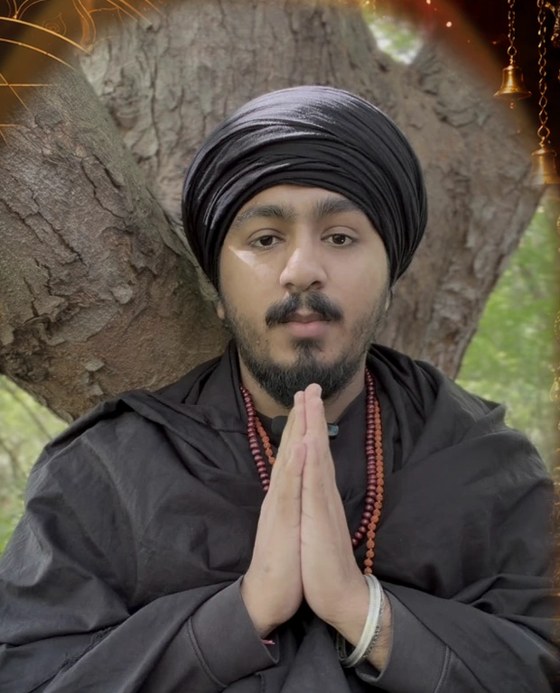 Live · 15 minutes · private video call
Speak with Acharya Shri Jashanpreet Singh Ji
Bring one question about your sadhana or your path. You meet the Acharya face to face on a private video call and leave with one practical next step.
per session
Book a 15-minute video session →
 Written report · 24–28 pages · confidential
The Ultimate Spiritual Analysis
A personal report prepared individually for you by Guru Amitacharya and the Mahakali Tantra Pith: Vedic astrology, aura and chakra reading, face and palm study, and a practical remedy plan, delivered as a private PDF.
See what the report covers →
Guidance is spiritual in nature, given honestly and for your good. Payment is secured by Razorpay in Canadian or US dollars.